Growth
We build the system that finds you customers.
Websites, tracking, local SEO, catalogs, and follow-up systems, built around demand you can measure.
- Projects
- 18
- Figures published
- 16
- Free first step
- Pipeline Map
- Fixed price from
- $2K
6 written up on the work page
listed on the work page
built from your site and a note on how buyers currently reach you
Outbound Engine Build
Is this you
The week this fixes.
Sentences we hear from the people who end up sending this practice a bottleneck, and what each one is costing while it stays true.
“People search for what we sell and find someone else.”
Demand that already exists, converting for a competitor.
“Our sends started bouncing. We re-verified the list and they are still bouncing.”
It is one of three causes, and re-verifying only fixes the first.
“Our SDR spends two days a week on research.”
Someone paid to sell, spent on building lists.
“We cannot tell which half of the marketing spend is working.”
A renewal decision made on instinct every year.
What a project covers
Scoped to the smallest useful system, judged against a number.
- Website and growth systems: site, tracking, local SEO, catalog, and follow-up, scoped to the demand that exists
- Search growth measured in Search Console, with the numbers published on the work page
- Measurement first: every growth engagement starts with what we will count
What that has looked like
- Local search demand turned into a working ordering path
- Tracking that shows which channel a customer actually came from
- A follow-up system that runs even when the team is busy
The measures we agree before building
One of these is picked with you at the scoping step, and reported against.
- Qualified enquiries, and impressions and clicks behind them
- Speed of first response to a new lead
- Share of demand that converts instead of leaking
When the sending stops working
Sends bounce for one of three reasons.
Most people re-verify the list, which only fixes the first of them. Telling the three apart is a question your own bounce log can answer, and it is the thing worth doing before buying anything.
| Cause | What the log looks like | What actually fixes it |
|---|---|---|
| The list | Hard bounces spread evenly across every receiving domain. | Verification and a suppression file that actually gets applied to the next send. |
| The sending setup | Bounces clustered by mailbox or by sending domain, or authentication failing outright. | SPF, DKIM and DMARC alignment, reverse DNS, warm-up, volume per mailbox, and the tracking domain. |
| The domain reputation | Blocks and deferrals, with specific providers rejecting while others accept. | Blocklist remediation, resting the domain, resetting volume, and changing the content and the links. |
What we will tell you without being asked: there is no point in dedicated IPs at low volume, shared hosting mailboxes are finished for cold email, most blocklists are noise while Spamhaus is not, Germany and Austria carry real privacy exposure, and Australia is excluded outright under its spam law.
No charge, no call
2 free ways to start.
Each is a document or a sample, written by the person who would do the work. Send one input, get something back you can act on or ignore.
Free
Pipeline Map
Where demand is leaking, and which leak is worth fixing first.
You send: Your site, and a note on how buyers currently reach you.
You get back:
- Where the demand that already exists is going instead
- What is not being measured, so nobody can tell the spend is working
- The one fix to make first, and what it would be judged on
Free
Bounce read
Send a thirty-day bounce-log export. Get back which of the three causes it is, with the evidence.
You send: A thirty-day bounce-log export from whatever you send through.
You get back:
- Which of the three causes the pattern points to: the list, the sending setup, or the domain reputation
- The evidence in your own export that says so, quoted back
- What to do about that cause, in order, including the parts you can do yourself
Every free first step across the five practices is listed together, if the problem sits between two of them.
Entry points
The ways in, each priced before work starts.
Start with one. None of them requires the next one, and each is small enough to judge on its own.
Website and Growth System
Build the site, tracking, local search, catalog, or follow-up system around demand you can measure.
Scoped case by case · Agreed before work starts
Outbound Engine Build
We build the outbound system and you own it: lists, mailboxes and domains, sequences, tracking. No platform of ours in the middle.
$2K–$4K · Fixed price · optional monthly run · 2 to 3 weeks
Deliverability Diagnostic
After the free bounce read: authentication and infrastructure checked, the list cleansed, a suppression file built, and a fix list in priority order.
$300–$700 · Fixed price · About one week
Lifecycle Email Build
The follow-up emails that should already be sending, sending. Written, built, and handed over in your account.
$1.5K–$3K · Fixed price · 2 weeks
Every price, fixed or by the hour, is agreed before work starts and built the same way: the hours, the tools, and a share of company cost. See how a price is built
The free first step
What the first move looks like.
Examples of what we sent back after a bottleneck came in.
A marketing diagnostic for a home-services company and its franchise armWhat happened: Proposal only. No build followed.
A dryer-vent service with a franchise programme asked what its marketing was actually doing, and what to fix first.
What it covered
- A short diagnostic of the site, the tracking, and the content as they stood
- A two-funnel site structure: one path for customers, one for prospective franchisees
- A measurement plan (analytics, tag management, ad pixels) so spend could be judged
- A content cadence sized to what the company could sustain
- The first move
- Fix measurement and the two funnels before spending on content or ads.
A channel viability study before any spendWhat happened: Study prepared; follow-up pending at the time of writing.
A consumer brand wanted to know which growth channel to commit to, and did not want to find out by funding all of them.
What it covered
- A scoring framework: reach, cost to test, fit with how the product is bought
- The channels ruled out, with the reason for each
- A short feasibility sprint on the channel that survived, followed by longer pilots only if it earned them
- The first move
- A short feasibility sprint on one channel, with the pilot decision made on its result.
A ninety-day paid-search trial plan for a roof-restoration companyWhat happened: Plan viewed and a brief received; the partner ran the account.
Through a partner agency, a roofing company wanted paid search tried properly before deciding whether to keep paying for it.
What it covered
- Keyword research from the search-intelligence tool, mapped to the services that pay
- One campaign structure for ninety days, with the budget band and lead target as the client stated them
- The single measure the trial would be judged on: cost per qualified lead
- The first move
- Ninety days, one campaign, judged on cost per lead.
The work
What this looks like shipped.
Fish Frenzy: Turning local search demand into a usable three-location ordering path
6.37K clicks / 174K impressions
WordPress and WooCommerce site with zip-code-based online ordering for a three-location seafood restaurant, integrated with the Clover point of sale, plus social content and local campaigns, with the search growth to show for it.
Read the case study
Kevin Champeny: Search visibility and content architecture for a contemporary artist
766 clicks / 8.25K impressions
A keyword cluster built around a mosaic art pillar page, an editorial brief and an 11-page article written to it, a robots file fix from a site audit, and the Search Console window that followed.
Read the case study
AI Mark Labs: A technical and creative team inside a marketing agency, for a calendar year
15 to 70 clicks per 28-day window
A year of weekly reporting discipline inside a marketing agency: dashboards and return on ad spend per account, plus search work on the agency's own site with the Search Console window on record.
Read the case study
A cold-outreach engine we ran on our own pipeline first
247 qualified leads
Contact sourcing from Apollo, verification, warmed secondary sending domains, sequenced copy, reply triage, and weekly deliverability reporting. We ran it at scale on our own program through the second half of 2025, then for a partner under their brand, as a pilot for a client, and on hourly contracts.
Read the case study
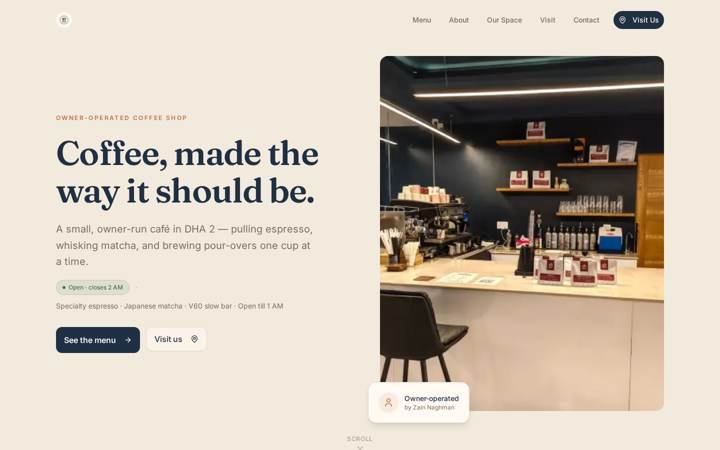
93 Brew: A café website the owner can update without a developer
A customer website for a café: prices and items are changed in one place and update across the site, each drink has its own page, and the site is set up to be found in local search. We hold a stake in the café.
Read the case study
A visual-content and motion brief for an AI-assisted healthcare billing product
An 11-page visual and motion content brief: brand translation, still-graphic direction, short-loop animation direction, and a 12-second scene plan.
12 more growth projects
What else we have built in this area, and what changed as a result.
Engagements in this catalogue, described without numbers and, in most cases, without the client: they were built under confidentiality or under another firm's brand. For numbers with sources behind them, see the work page.
Finding out which spend was actually working
Ad spend was renewed on instinct because nothing connected an enquiry back to the channel that produced it.
What we built
- Tracking rebuilt so a lead carries its source through to the CRM record
- Consent-aware measurement, rather than tracking that quietly breaks under a cookie banner
- Reporting that shows cost per qualified enquiry, not cost per click
- Removal of the tags and pixels that were firing but feeding nothing
What changed
Renewal decisions started referring to a number, and some spend was stopped rather than renewed.
Multi-location local search that stopped competing with itself
A business with several branches had locations outranking each other, duplicate listings, and inconsistent details across directories.
What we built
- One page per location with genuinely distinct content, not a template with the town swapped
- Listing and citation consistency across the directories that feed local results
- Structured data so each location is machine-readable as a place, not just a page
- Measurement per location rather than one site-wide number
What changed
Branches stopped cannibalising each other's search results, and each location's performance became separately visible.
First response, in minutes rather than when someone noticed
Enquiries landed in a shared inbox and were answered whenever someone opened it. Weekend leads were often answered on Tuesday.
What we built
- Routing on arrival, by enquiry type and availability, into an owner rather than a shared pile
- An immediate acknowledgement that is genuinely useful rather than an autoresponder
- Escalation when a lead goes unclaimed past a threshold
- Follow-up sequences that stop the moment a human replies
What changed
Response time stopped depending on who happened to be looking at the inbox.
A company site, from domain to launch
A Riyadh technology company needed a site that described what it actually sold, and needed it quickly.
What we built
- Domain and hosting set up as part of the engagement rather than left to the client
- A full site build, written for what the company sells rather than filled into a template
- On-page search work carried through every page as it was built, not added afterwards
What changed
The company had a site matching what it sells.
A target-account list built from hiring signals
A prospect wanted a target list built from something more current than a firmographic filter: who is hiring for the role that implies the problem.
What we built
- Accounts identified from hiring signals rather than from a static firmographic cut
- Owner-level contacts resolved against each account and enriched
- Delivered with a guided walkthrough so the team could run the same build again themselves
What changed
The prospect had a list built from a current signal, and a recorded method for rebuilding it.
A security firm's site rebuilt, and their team taught to run it
SecureMax, an established security company, had a site that no longer matched what it sold, and no way to change it without calling someone.
What we built
- A custom rebuild across the full page set rather than a template refit
- Technical and on-page SEO work through the whole rebuild, not bolted on after
- Content restructured around what buyers actually search for
- Performance work, and training so their own staff could publish and edit
What changed
The site started matching the business again, and updating it stopped requiring an outside call.
A single-site restaurant's whole digital presence, rebuilt
A restaurant's online presence was a scattering of profiles nobody owned, and its ordering path did not match how people actually found it.
What we built
- Site and menu rebuilt around the ordering path rather than around the brochure
- Local listings and profiles brought into line with each other
- A social and content routine the owner could sustain without an agency
- Measurement, so the next decision had something behind it
What changed
The restaurant's online presence became one thing that pointed at ordering, rather than several that pointed nowhere.
Merchant Center kept healthy for a jewellery brand, until hand-over
A jewellery brand's shopping listings needed someone watching Merchant Center: disapprovals, feed errors, and what the traffic was doing.
What we built
- Monthly performance reporting from Merchant Center
- Feed and listing fixes as disapprovals appeared
- A clean hand-over when the account moved in-house
What changed
Listings stayed live and the brand had a monthly read of its shopping traffic, until it took the account over itself.
An email-infrastructure review for a partner's outbound team
A partner running cold outreach wanted an outside read on its sending infrastructure before scaling it.
What we built
- An audit of the sending setup: workspace, sending tool, domains, authentication, warm-up
- The ideal-customer definition and copy framework reviewed against what the infrastructure could carry
- Verification and reseller economics, with the numbers the partner should watch
What changed
The partner had a written view of what would break at scale before it scaled.
A brand system and sixteen months of social content for a computer wholesaler
A South African computer wholesaler needed a logo and icon system, a steady content stream, and a Shopify presence while it built its B2B search visibility.
What we built
- A logo and icon system
- Weekly content sets, reels, and mobile video over sixteen months
- Shopify store set-up support and the paperwork for a certified-refurbished marketplace status
- Search visibility measured in Search Console; the window is on the work page
What changed
The wholesaler posted every week for over a year without an in-house designer, and its search numbers are on the work page.
Paid social, a content calendar, and monthly reporting for a restaurant
A restaurant needed paid social and content run for it, through its agency, with a monthly report the owner could read.
What we built
- Pixel set-up on the existing site and the first campaigns
- A monthly content calendar and a storytelling ad set built from the restaurant's own photos
- Influencer outreach
- A monthly campaign report
What changed
The restaurant had campaigns running and a report each month, instead of a page nobody posted to.
A search audit for a studio with almost no search presence
A design studio was competing for attention with agencies whose sites had years of search history behind them, and had no read on where it actually stood.
What we built
- A crawl-based audit of the studio's own site: authority, indexed pages, and the terms it could realistically compete for
- A named competitor set, read against the same measures rather than against an impression
- The findings written up as a document the studio could act on without us
- A follow-on proposal written against what the audit found
What changed
The studio stopped guessing where it stood and had a document that said so, including the parts that were unflattering.
Elsewhere on the site
Read next
- PrototypesLabsWorking prototypes on sample data, including the kind of surface this practice builds. Nothing there is a client system.
- The workThe workCase pages, the systems that could not be named, and every figure with its source.
- The workThe evidence registerEvery record behind the work page, what kind of evidence each is, and what is withheld.
Where to next
The free first step: a Pipeline Map.
Send your site and a note on how buyers currently reach you. That is all we need to start.